From the studies carried out, we now know that our genome is 70% similar to that of the chimpanzee and 15% to that of the gorilla (Durbin, Dutheil and Scally, 2012).
What we share with the great apes is not only appearance or physiology, but also the range of behaviors and emotions. Only fifty years ago, primates were viewed in a completely different way, and for a long time in the West the image of the gorilla remained that of a testosterone-fueled King Kong, wandering madly about and kidnapping women. In the 1960s and 1970s, some fearless women changed primatology: their studies on chimpanzees, gorillas, and orangutans rank among the longest field research projects ever carried out on single populations of wild animals.
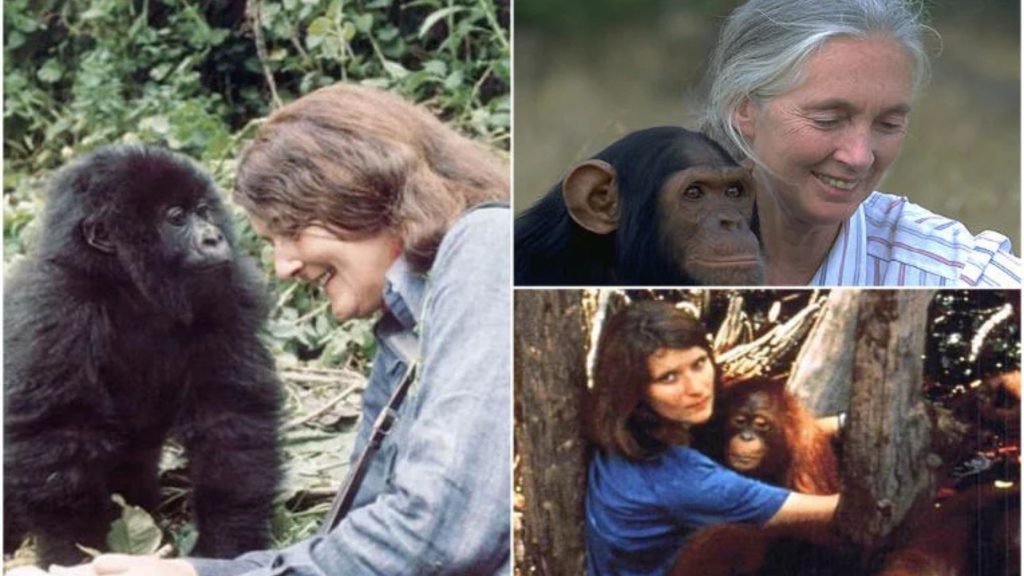
Jane Goodall, Dian Fossey, and Biruté Galdikas fought and continue to fight to spread knowledge and encourage conservation and protection of the great apes and, each with her own original contribution, they redefined the relationship between human beings and other primates.
Jane Goodall (April 3, 1934 – October 1, 2025)
Jane Goodall was born in London in 1934. From a very young age she showed great interest in animals in general. While her peers devoted themselves to brushing dolls, Goodall read Tarzan and Doctor Dolittle and sneaked into the chicken coop to see where eggs came from. She dreamed of one day going to live among wild animals and, luckily for her, her mother encouraged her wholeheartedly to pursue her dreams, at a time when girls were certainly not urged to devote themselves to science. At the age of twenty-three, together with a friend, she traveled to Africa, where she met the famous paleoanthropologist Louis Leakey. At that time, Leakey was conducting pioneering research on the origins of humankind, determined to demonstrate Darwin’s theory that human evolution began in Africa; moreover, Leakey was convinced that the more one searched in the past, the more one could learn about the connections between humans and other primates.
When Goodall began her path, little was known about the behavior of great apes in the wild. Leakey was impressed by the enthusiasm and energy of the young woman, so much so that he appointed her his assistant and asked her to lead a research project on chimpanzees in Tanzania. In the summer of 1960, Goodall arrived at the base in the Gombe area and began observations. It took some time for the chimpanzees to get used to her presence, but in a relatively short period Goodall managed to accumulate a series of notes sufficient to shock specialists and the general public: chimpanzees are not vegetarians, but also feed on meat. Goodall had observed that chimpanzees adopt precise hunting patterns and feed not only on insects but also on small primates such as colobus monkeys.
Shortly afterwards, she made a second revolutionary observation: she saw two chimpanzees strip the leaves off some twigs, insert the bare ends into a termite mound, and extract the insects to eat them. It was proof that not only do primates use tools, but they are also able to make them. Until that moment, anthropology had defined humanity precisely by the ability to make tools. Goodall reported her observations in writing to Leakey, who responded with the famous phrase:
“Now we must redefine the concept of tool, and we must redefine the concept of man, or we must accept that chimpanzees are human.”
That was in 1963.
In 1964, Goodall married the wildlife photographer Hugo van Lawick, a Dutch baron. Their son, Hugo Eric Louis, whom she affectionately nicknamed Grub, was born from this marriage.
At the same time, Leakey managed to enroll the researcher at the University of Cambridge to obtain a master’s degree in natural sciences, despite the fact that Goodall did not have a university diploma: she would have to submit her observations to the judgment of the examining committee, and the objection raised against her was that of assigning proper names to the subjects of her study rather than numbers, as was customary in ethology. But Goodall studied individuals, and individuals have names—her chimpanzees were called David Greybeard, Fifi, and Goliath—because the emotions they felt and the complexities they showed could not be conveyed by a number, she objected. Her chimpanzees displayed gestures recognizable in humans, such as hugs, kisses, pats on the back or head, tickling—all behaviors that serve to create close, loyal, and lasting bonds among members of the same family and community.
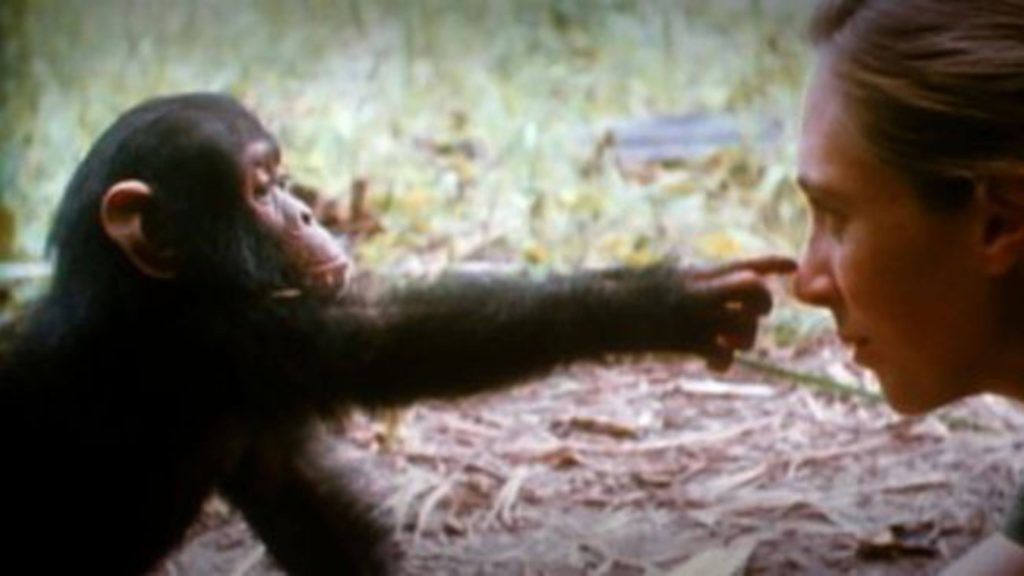
She also observed aggressive behaviors, since within chimpanzee communities social hierarchies often establish themselves through conflict and violence. Goodall observed dominant females killing younger females and practicing cannibalism in order to maintain their dominant role.
In 1965 Goodall founded the Gombe Stream Research Centre, still active today. After separating from van Lawick in 1976, she later married Derek Bryceson, a member of the Tanzanian parliament and director of the country’s national parks. Thanks to his influence, Bryceson protected the Gombe reserve until his death in 1980.
In 1977 the researcher founded the Jane Goodall Institute, in support of conservation and development projects in Africa, including a section dedicated to youth programs called Roots & Shoots.
Goodall observed behaviors never before documented – cooperation, altruism, sadness, joy, cruelty – and paved the way for other primatologists who were about to begin their careers, such as Dian Fossey.
Goodall’s research demonstrated that chimpanzees:
- 1960: use and make tools; eat meat.
- 1964: show evidence of planning actions to achieve specific goals; use handmade objects.
- 1966: are susceptible to contracting polio and AIDS.
- 1970: express wonder (they have been observed dancing beside a waterfall).
- 1974: wage wars between groups.
- 1975: practice cannibalism; form coalitions to challenge established social status; transfer females from one social group to another.
- 1987: adopt orphaned chimpanzees and raise them as their own children.
- 1994: form short-term monogamous relationships; observe and learn to make tools by watching other chimpanzees.
- 1995: can give birth to twins; chew medicinal plants.
Dian Fossey (January 16, 1933 – December 26, 1985)
While Goodall was settling in Gombe National Park, Fossey decided to use her savings for a trip to Africa. Born in 1932 in San Francisco, she had an upbringing completely different from that of Goodall. In constant conflict with her parents, she grew up in solitude, seeking affection and acceptance in the company of animals. Her family opposed her wish to study biology, and so she settled for a degree in occupational therapy, after which she moved to Kentucky to work in a pediatric hospital. For ten years, Dian worked as a therapist treating sick children, while living on a farm where, in her free time, she cared for animals. Although she loved living on a farm and working with children, it was not enough. In 1963 Dian invested the money from a loan, equal to a year’s salary, in a seven-week trip to Africa. There she met Leakey, an encounter that would become legendary: during that meeting, as she was observing a giraffe fossil that Leakey was proudly showing her, she slipped on the specimen, sprained her ankle, and vomited. That was Louis Leakey’s first memory of Dian Fossey!
During the final stage of her trip, she followed a tracker into the dense Ugandan jungle to see a group of shy mountain gorillas and was utterly fascinated. She returned home to Louisville to pay off her travel debts and published three articles in the local newspaper, The Courier-Journal, in which she recounted her African experience. Later, when she learned that Louisville would be one of the stops of a Leakey lecture tour, Fossey managed to meet him again. Three years had passed since her trip to Africa, but the anthropologist remembered Dian perfectly and agreed to send her back to Africa, this time to manage a research project on mountain gorillas. For this purpose, Leakey suggested she have her appendix removed, a precaution due to horrifying stories he had heard of deaths caused by appendicitis attacks in the middle of the jungle. Dian followed his advice and had the appendix removed, only to find out later that the request had been a test by Leakey to check her true determination!
In 1967, at the age of thirty-five, Dian was leading a research camp, first in Congo and then in Rwanda. She would live among the gorillas for eighteen years and would recount this part of her life in the book Gorillas in the Mist.
Within a short time, Dian founded the Karisoke Research Centre, whose name came from the combination of the two volcanoes between which the camp was located, Karisimbi and Visoke. She found herself living in a small tent, eating canned food, and spending her time spying on gorillas. Since these animals knew humans only in the form of poachers, she initially had difficulty approaching them. In an attempt to lower their alert level, she began to imitate them: she scratched herself conspicuously, grunted, chewed bamboo shoots while walking on all fours, supporting herself on her knuckles. She acted in a non-assertive manner so as not to irritate the animals. Once some individuals accepted her presence, the woman began to truly observe them: she started to recognize them by identifying their nasal prints, formed by the shape of their nostrils and transverse folds of the nose, a method of identification that biologist George Schaller had introduced a few years earlier in his pilot study of gorillas.
Fearing not to be taken seriously due to the lack of specific academic qualifications, under the same supervisor as Goodall, Fossey obtained a master’s degree at Cambridge. Later, she began to compare her success in habituating gorillas with her previous work in occupational therapy. During her time at Karisoke, Fossey observed the social dynamics of gorillas: individuals created strong family bonds, which led them to fiercely defend the young of the group, care for the injured and weaker members. She observed that some females were transferred from one group to another; she tracked the daily distances traveled by the animals and studied their vocal patterns; she noted that their diet consisted mainly of plants, with sporadic cases of coprophagy to recycle nutrients made possible by re-ingesting seeds. She also observed rare cases of cannibalism and infanticide. Like Goodall, she assigned proper names to the gorillas she observed, based on their characteristics and personalities.
Over time, her focus shifted from study and observation to the protection of gorillas, persecuted by poachers. Her tireless activity focused on preventing them from being captured, killed, or ending up in traps set by hunters to catch other animals. Sometimes poachers captured infants to sell on the exotic animal market: this led to the slaughter of the entire group from which the infant came, as the adults fought vigorously to defend it. The heads, hands, and feet of gorillas were cut off and sold as grotesque trophies—the hands used as ashtrays. For the locals, Fossey became “the solitary woman who lives in the mountains.”

In 1977 things took a dark turn: Digit, Dian’s favorite gorilla, with whom she had established a profound ten-year bond, died. He was killed while trying to defend his family, and his decapitated body was found. For Fossey, this was a declaration of war, and from that moment she decided to manage things personally: she created the Digit Fund to finance anti-poaching patrols, destroyed traps, intimidated poachers she captured, and reportedly even seized livestock from locals to demand ransom and burned hunting outposts. She managed to obtain the arrest of several poachers, many of whom were sentenced to long prison terms; she strongly opposed eco-tourism because gorillas died from certain diseases brought by humans, such as measles. In 1978 she tried to prevent the sale of two baby gorillas from Rwanda to Germany, destined for the Cologne Zoo. During the capture of the two infants, twenty adult gorillas were killed while trying to defend them. The Digit Fund, now known as The Dian Fossey Gorilla Fund International, continues to finance daily monitoring carried out by the Karisoke Research Centre.
On the night between December 25 and 26, 1985, Dian Fossey was brutally murdered with machete blows in her cabin. Despite the many theories surrounding her killing, the case was never solved, but it is certain that her death sentence was only a matter of time: a few months before her murder, Fossey had signed a million-dollar contract with Universal Studios for a film based on her book Gorillas in the Mist. This contract would have allowed her to continue living among her beloved gorillas for a very long time.
Her grave is located at Karisoke, beside that of Digit.
Although some accused Fossey of acting like a guerrilla fighter, her determination and incredible courage drew the attention of the scientific community to the importance of protecting mountain gorillas. Today, Rwanda continues to protect this species, and the population has instituted Kwita Izina, an annual ceremony in which every newborn gorilla is given a name and the importance of protecting the gorillas and their habitat is celebrated.
Biruté Galdikas (May 10, 1948 – March 24, 2026)
Biruté Galdikas was born in 1946 in Germany. Her Lithuanian parents were on their way to Canada. The future primatologist thus grew up in Toronto, where already at the age of five she began to take an interest in the origins of humankind and its relationship with other apes. At six she read a children’s book from the Curious George series and was fascinated by the explorations described in it. During her childhood, she spent a great deal of time in the woods, exploring and imagining herself as a native, a Huron or an Iroquois, observing wild animals. Throughout her school years she nurtured an interest in the great apes, until she decided that her favorites were the red apes of Asia, the orangutans. At the age of nineteen she became fascinated with Jane Goodall’s research and dreamed of pursuing the same activity with orangutans.
After a degree in psychology and zoology, at twenty-two she was studying for a master’s in anthropology at UCLA when it happened that Louis Leakey came to give a lecture at that very university. The young woman introduced herself to the researcher and told him about her wish to study orangutans in Asia. Once he overcame his initial hesitation, Leakey was persuaded to support her and fund a project. Three years later, in 1971, Galdikas traveled to Borneo, headed to one of the few places on the planet still completely untouched, the Tanjung Puting Reserve in southwestern Borneo. Leakey and the National Geographic Society helped her set up a base: a hut with a thatched roof in the middle of dense rainforest, without electricity and without access to any village. Galdikas could not have been happier and named the site Camp Leakey.
Months would pass before she managed to catch sight of an orangutan, and the difficulty of observation led her to develop strategies to begin monitoring the behavior of this species: once she identified an individual, she would follow it without hesitation until it entered its nest for the night. The next morning, she would resume from the nest, continuing the observations where she had left off the day before. Tracking the orangutans led her into the most intricate and dense parts of the forest, sometimes forcing her to remain waist-deep in swamp water, at the mercy of ever-present leeches. She often ended up with a stiff neck from spending so much time looking upward, trying not to lose sight of the chosen subject.
Before Galdikas, orangutans were the least known of the great apes. Today, thanks to her, we know them better and several previous assumptions have been disproven.
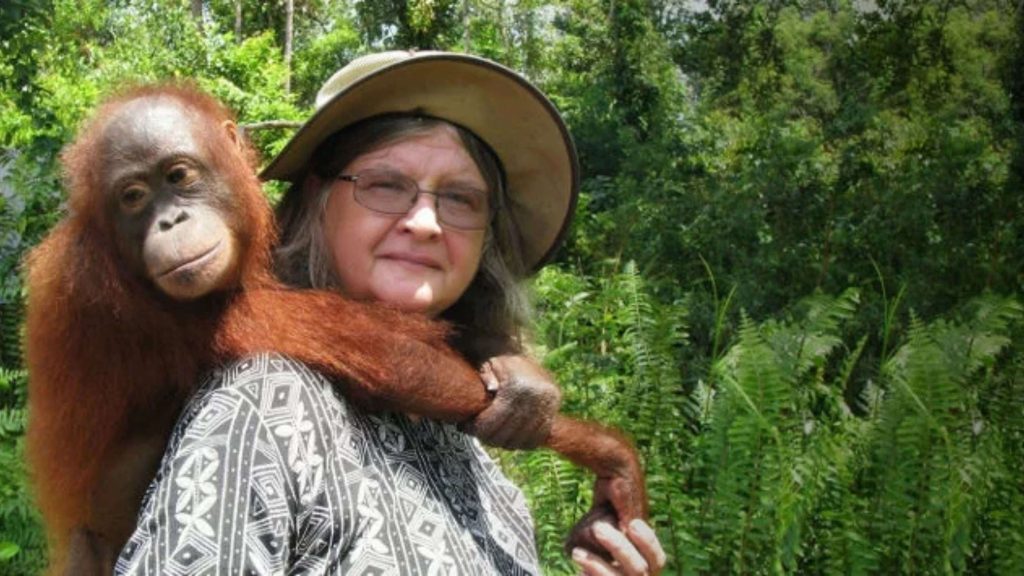
It is not true that orangutans live in perpetual solitude: the young display social dynamics and begin to develop the tendency to remain alone as they age. Their migration patterns have been studied, showing that some populations remain in the area where the group formed, while others are more nomadic. In addition, Galdikas was the first person to document the orangutan life cycle: thanks to her, we know today that females usually reproduce only once every eight years, and that the single infant born remains with its mother throughout that time. For the first ten years, infants maintain a very close bond with their mothers, staying in constant contact with them, clinging tightly. Such a slow reproductive cycle exposes them to a very high risk of extinction. Only adult males truly lead solitary lives, spending most of their time walking through the forest in search of food. Galdikas also discovered that they sleep in nests in trees that can be up to thirty meters high; they eat more than four hundred varieties of food and, during storms, wrap large leaves around their backs as makeshift ponchos.
She demonstrated that non-human animals also have culture, observing about thirty behaviors present in one population of orangutans and absent in another, showing that such behaviors were passed down from generation to generation and were learned.
Galdikas also witnessed orangutan hunting at the hands of poachers, who sought meat, tourist souvenirs, medicinal products, or captured them for the live animal trade. She therefore created the Orangutan Foundation International, which helps raise orphaned orangutans. Her detractors argued that observations of orphaned orangutans raised in the camp could not provide reliable data on the behavior of orangutans in the wild and therefore accused the project of lacking scientific rigor. Nevertheless, Galdikas also continued her observations in the natural habitat.
In 1995 she published Reflections of Eden, which gathered her memories at Camp Leakey and described the attempts to rehabilitate orangutans she later released.
Over the years, she developed very intense relationships with the orphaned orangutans she raised: many of them clung to her during movements, shared meals with her, and slept by her side. The scholar stated that the intensity and strength of these bonds was equal to that of interactions among human beings.
The “Trimates”
The expression “Trimates” was coined by the paleoanthropologist Louis Leakey in the 1960s. Convinced that the key to understanding human evolution lay in the study of our closest relatives, the great apes, Leakey promoted three long-term field research projects, each entrusted to a young woman whom he believed to be exceptionally motivated and intuitive:
- Jane Goodall, who studied chimpanzees in Gombe, Tanzania
- Dian Fossey, who studied gorillas in Karisoke, Rwanda
- Biruté Galdikas, who studied orangutans in Camp Leakey, Borneo
Leakey referred to them collectively as the Trimates,, literally “the three mates” or “the three companions.” The term not only reflected the number of researchers but also highlighted their pioneering role in reshaping primatology and our understanding of the relationship between humans and other great apes.
Conclusion
Goodall, Fossey, and Galdikas have shown that human beings are not as special as they believe and that many of our behaviors are neither unique nor exclusive to our species: other primates are equally complex, capable of cooperation, cruelty, sadness, happiness, and altruism, and capable of observation just like humans.
Unfortunately, despite their immense efforts, the survival of the animals that were and still are the subject of their studies is gravely at risk, as are their habitats, perhaps irreversibly compromised.
Bibliography
Goodall, J. (1971). In the Shadow of Man. Boston: Houghton Mifflin.
Fossey, D. (1983). Gorillas in the Mist. Boston: Houghton Mifflin.
Galdikas, B. (1995). Reflections of Eden: My Years with the Orangutans of Borneo. Boston: Little, Brown & Company.
Morell, Virginia. Called ‘Trimates,’ Three Bold Women Shaped Their Field. Science, 16 April 1993.