Similar Structures, Different Perceptions
Even when sensory channels are shared, there are considerable differences in perception between species. Sometimes these differences are clearly discernible, since the organ responsible for perception within a given sensory channel already shows significant variations. Other times, the differences are more subtle, but no less important.
When we look, listen, smell, or touch something, we don’t perceive the world “as it is” in an objective way. It’s not that certain elements naturally impose themselves on our attention because they are more obvious. On the contrary, it is we ourselves, or, rather, our brain and our senses, who select and assign importance to certain stimuli over others, based on criteria specific to our species.
Therefore, what we see, hear, or perceive is always the result of a “perceptual choice,” shaped by how our mind works. Even though it may seem at first glance that everyone sees or hears the same things, in reality each species constructs its own unique representation of reality.
The similarity is only apparent.
How Many Types of Eyes?
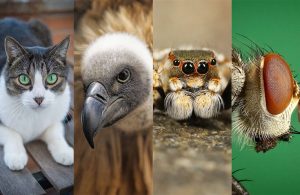
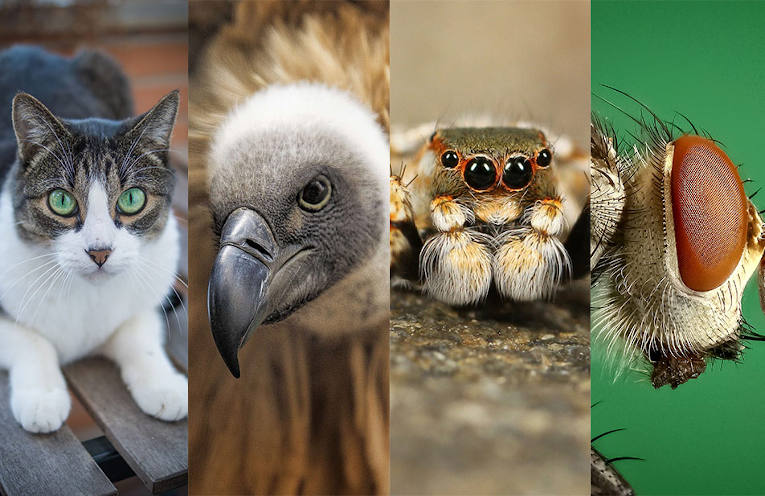
Let’s take sight, for example. In the animal kingdom, eyes come in a wide variety of forms: from the compound eyes of insects, made up of many small units called ommatidia, to the eyes of mollusks with adjustable-focus crystalline lenses, to the telescopic eyes of crustaceans and the independently moving eyes of chameleons. The position of the eyes in relation to the skull also determines two very important parameters, which vary among animal groups:
- Field horizon, which is broader the more laterally the eyes are positioned, like in animals that live in open spaces and usually have a grazing lifestyle;
- Depth of field, which comes from forward-facing eyes allowing for binocular vision, typical of arboreal animals, predators, and omnivores.
There are also more minute, less obvious differences, so much so that few people realize the image of the world perceived by a dog or a cat is quite different from the human one.
Human Vision
Our species, like other anthropoids, evolved in a lush environment with a predominantly omnivorous, gatherer lifestyle, and developed a sensitivity to mid-to-low wavelengths of light—for example, colours ranging from yellow to red. Being able to distinguish green (leaves or unripe fruit) from yellow (ripe fruit)—that is, strongly discriminating between two frequencies—and having an attraction to red, which stands out and is easily perceived (a prototypical stimulus), gave us clear survival advantages, considering the diet and habitat of our ancestors. This preference persisted even when early australopithecines left—or rather, found themselves outside—the forest environment and shifted their diet toward a greater intake of eggs, larvae, and animal carcasses.
Seeing at Dusk
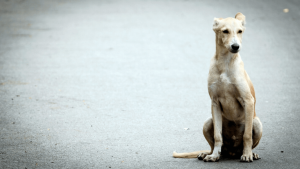
Things are different for crepuscular predators like leopards or wolves, which are more sensitive to other frequencies such as blue or violet, and possess a tapetum lucidum—a structure that reflects photons, effectively doubling the brightness of a scene. For a dog, colors like green, yellow, orange, and red are not seen as separate entities but appear as a band of yellowish hues, which are generally uninteresting. On the other hand, what we perceive as a range of blues might be something entirely different for the dog.
References:
Roberto Marchesini, Geometrie esistenziali, Apeiron, 2018.