What happens when we stop drawing strict boundaries between species? Can art offer a language to imagine interspecies futures beyond hierarchy, fear, and dominance? In this article, we explore the work of Karin Andersen, a German-born visual artist whose creative journey invites us to radically rethink our place in the biosphere.
The Artist as Posthuman Storyteller
Karin Andersen (Burghausen, 1966) studied painting in Bologna, Italy, and has built a wide-ranging international career across visual arts, animation, and theoretical studies on zoomorphism. She explores the fertile intersections of human-animal relations, ecological thought, and posthumanist philosophy.
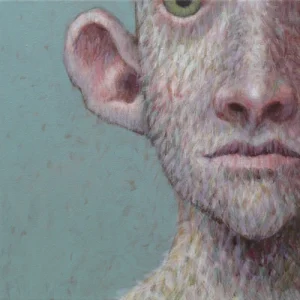
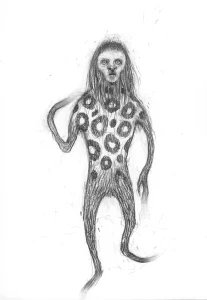
Her hybrid figures, often half-human, half-animal, challenge traditional portrayals of animality as something inferior, instinctual, or monstrous. Instead, they represent contamination, connection, and co-evolution.
As she writes in her artist statement:
“Theriomorphism in my work not only stands for cooperation with biological and social alterity, but for the necessity, inevitability and privilege of being hybrid.”
Zoomorphism Without Demons
Through the lens of theriomorphism—the artistic and mythological representation of animals or animal traits in deities and supernatural beings—Andersen challenges the foundations of the anthropocentric worldview. Rather than portraying animals as primitive, instinct-driven, or morally coded figures, she proposes a reinterpretation rooted in relationality and ontological proximity. Her approach is deeply influenced by the philosophical work of Roberto Marchesini, with whom she co-authored the book Animal Appeal. Uno studio sul teriomorfismo (2003), a critical exploration of the role of animal imagery in shaping human self-perception.
Where traditional iconography often reduces zoomorphic beings to binary oppositions—either divine hybrids endowed with power or bestial caricatures of instinct—Andersen introduces a third space: one of blurred boundaries, collaboration, and mutual contamination. Her hybrid figures are not metaphors of dominance or regression, but emissaries of a possible multispecies future, where diversity is neither exoticized nor erased, but acknowledged as the basis for coexistence. In her universe, difference becomes a fertile ground for imagination, empathy, and new forms of ecological consciousness.
Art in Dialogue: The Case of “Franz”
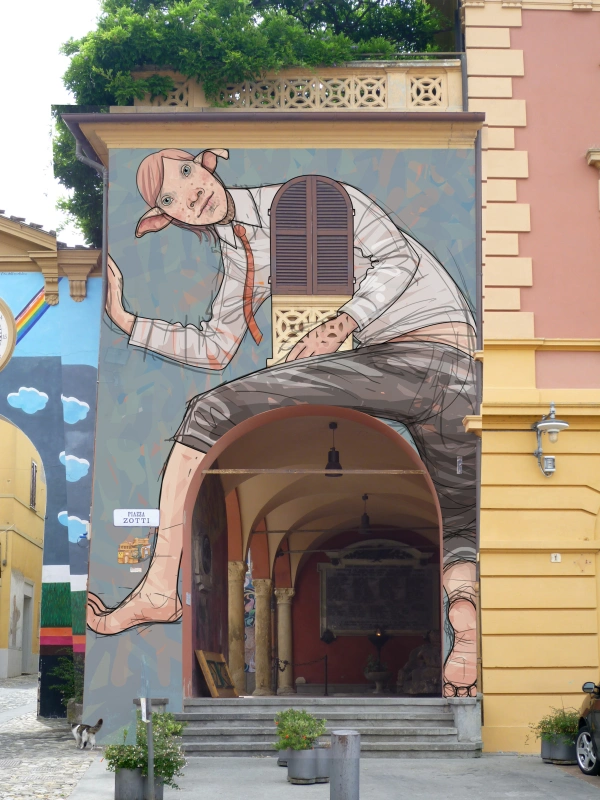
A turning point in Andersen’s career was Franz, a mural created in 2011 during the XXIII Biennale del Muro Dipinto in Dozza, Italy. Painting from a mechanical lift in a public piazza, she forged a dialogue with the local community that extended far beyond the immediate context.
Later, finding a photo of Franz in a German newspaper from her hometown, she reflected:
“Maybe it’s a matter of horizons, they can expand, even slightly, through initiatives like this.”
A dedicated exhibition room now displays the mural’s original sketch and a reflective text by the artist.
“My work has always been concerned with questions regarding ecology, according to its original meaning as the science about the relationships of different species or organisms with each other and with their natural or artificial environments.

Critters: A Bestiary for the Posthuman Age
Andersen’s fascination with hybrid beings continues in Critters, an independent art book curated by Cichinobrigante (Marcello Bertolla & Alessandro Mescoli). Its title nods to Donna Haraway’s use of “critters” as a way of referring to all kinds of living creatures without human-centered bias.
The book includes original drawings and a text by Roberto Marchesini, and was printed in a limited run, some signed, others featuring unique artistic additions. A true collector’s object for posthuman enthusiasts.
More Than an Artist
Karin Andersen’s artistic practice expands into video, film, scenography, academic writing, and visual design for scientific publications. She has collaborated with artists such as Christian Rainer, Cosimo Terlizzi, Daniel Lee, and Massimiliano Briarava. In 2023, she joined the scientific committee of the Centro Studi di Filosofia Postumanistica in Bologna.
Her works have been exhibited in prestigious venues such as:
– Artists Space (New York)
– Gallery of Modern Art (Bologna)
– Haus der Kunst (Munich)
– Guidi & Schoen (Genoa)
– Traffic Gallery (Bergamo)
Call to Action: A Mind Open to Hybridity
Karin Andersen’s art asks us to unlearn binary thinking and to see the world as a complex mesh of relationships. Hybridity, in her vision, is not an anomaly—but the very condition of life.
Want to explore more about multispecies thinking and posthuman philosophy?
Check out our related articles:
The Characteristics of Animal Intelligence
Sources: