Necrobotics is an emerging field that repurposes biological materials, specifically deceased organisms, as functional components in robotic systems. Unlike biohybrid robotics, which integrates living tissues, necrobotics utilizes non-living biological structures to perform mechanical tasks.
The first experiment with deceased spiders
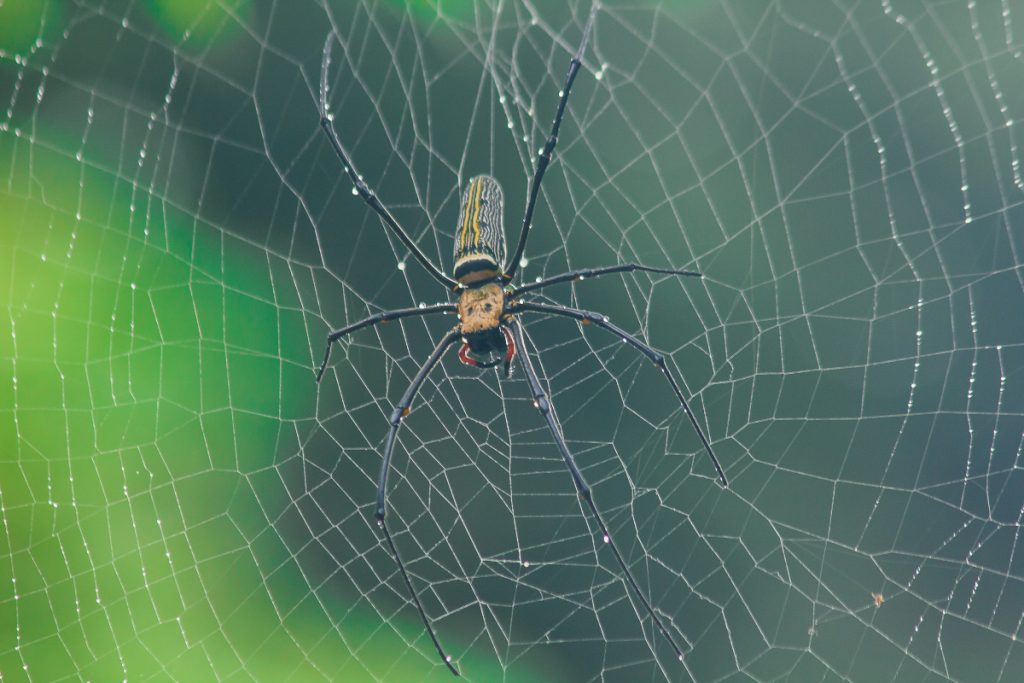
Unlike humans, who use pairs of agonist and antagonist muscles to achieve movement in both concentric and eccentric directions, spiders rely on a different mechanism. They possess flexor muscles that draw their legs inward, but lack extensor muscles. Instead, they extend them with hydraulic pressure they generate inside of their cephalothorax (prosoma). They pump haemolymph into their limbs to extend them; when the pressure is released, the flexor muscles contract the legs. After death, this mechanism ceases, leaving the legs curled.
Researchers have used this mechanism to transform spiders into mechanical gripper. A pioneering example came in 2022, when researchers at Rice University: by inserting a needle into the spider’s prosoma (cephalothorax) and applying pneumatic pressure, they could control the spider’s legs to open and close, causing the legs to extend and contract on demand.
Applications and Potential
This method allows the necrobotic gripper to lift objects weighing up to 130% of its own body weight.
One potential application is in micro-manipulation, such as handling microelectronic components. A complementary aspect is the possible reduction of waste streams, as dead organisms are biodegradable and/or compostable.
Beyond spiders, researchers are exploring the use of other organisms, such as pill bugs and chitons, to develop necrobotic systems capable of performing tasks, such as serving as terminal part of robotic arms, in various environments, including underwater operations.
Ethical Considerations
The advancement of necrobotics raises important ethical questions; The process involves euthanizing organisms, prompting discussions about the moral implications of using animal bodies for technological purposes.
There are also concerns about the potential progression from using simple organisms to more complex ones, possibly leading to controversial applications.
A concern, raised by Florian Pestoni in Why I’m Saying No to ‘Necrobotics’, relates to the issue of wear and degradation of organic tissues, and how this will be addressed.
It is to be hoped that, in this field, technology will meet not only biology, but also ethics.
References
Evan Ackerman, Necrobotics: Dead Spiders Reincarnated as Robot Grippers, 2022.
Josephine Galipon, Shoya Shimizu, Kenjiro Tadakuma, Biological Organisms as End Effectors, 2023.